
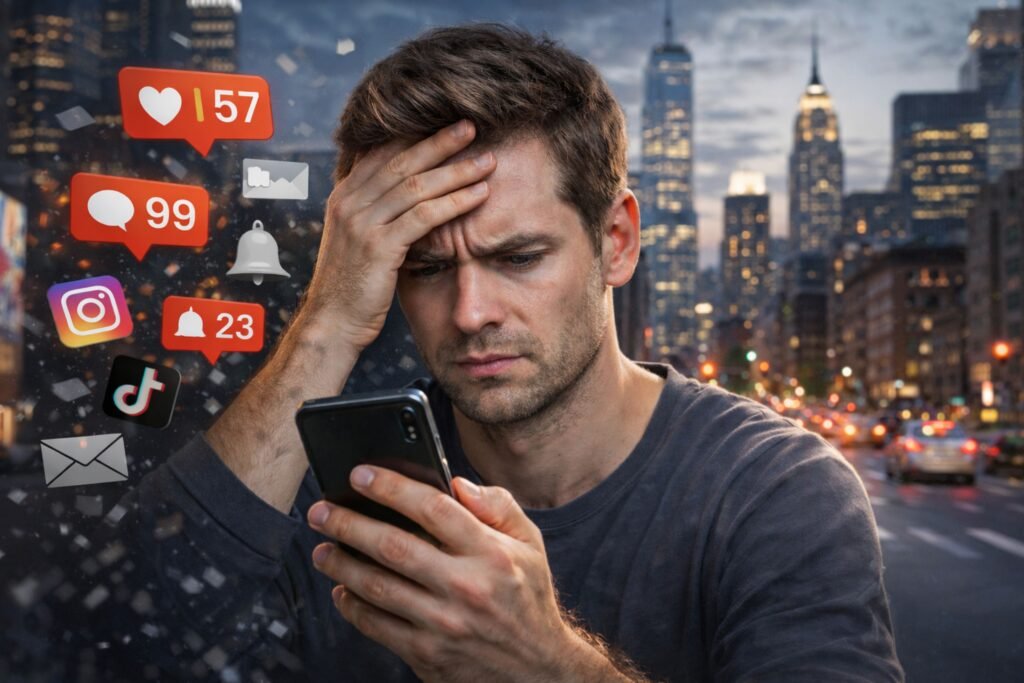
We carry the internet in our pockets. It wakes us up, guides us to work, answers our questions, entertains us while we wait, and keeps us connected to friends and family across the world. The technology inside our smartphones is more powerful than what NASA used to land Apollo 11 on the moon.
But somewhere along the way, that convenience has become expectation, and in turn, that expectation has become habit. Unfortunately, for many, that habit has become a dependency, a smartphone addiction even, which has a hidden cost to both our relationships with each other, and our mental health.
In 2014, the video of a spoken-word poem went viral. Not because it was funny or entertaining, but because it made for uncomfortable viewing. Look Up held a mirror up to a generation bent over glowing screens, scrolling through social media feeds and highlight reels, while life unfolded quietly around them.
Back then, we nodded and we shared it. We agreed. And then we carried on scrolling.
But today, more of us are beginning to question our relationship with technology.
In August 2024, I wrote one of my first blog articles on the benefits of a digital detox and how stepping away from constant input can improve our mental health. At the time, it felt important to me, as I was noticing how fragmented my own attention had become. How gradually, over time I had almost become addicted to my phone. The way I’d reach for my phone without thinking. The way time would slip by without me quite noticing where it went.
Later that year, a follow-up video poem was released, and the message had changed. In short, the first film sounded an alarm about digital distraction; the second returned to emphasise that we still hadn’t heeded it, and that the cost is now even clearer.
And the evolution in that message is important. Because what was once a cautionary tale about smartphones has become something far deeper. It’s no longer just about looking down at a device. It’s about living inside it.
The Hidden Cost of Smartphone Addiction in Everyday Life
Walk into any café, bar or restaurant, and you’ll find couples sitting opposite each other in silence. They’re not angry with each other, they’re simply elsewhere.
Families gather around tables with four plates and four screens. Friends meet to ‘catch up’ while filming content about catching up. No one planned for this to happen. It crept up on us slowly.
We’ve told ourselves we’re staying connected. And in many ways, we are. We can message someone across the world in seconds. We can see baby photos instantly. We can share milestones in real time.
But connection isn’t the same as closeness. You can have 5,000 followers and still feel profoundly alone. And if we’re honest, many of us do.
Ask yourself this:
- When was the last time you had a conversation without checking your phone?
- How often do you reach for a screen in moments of silence?
The Illusion of Being Seen
In 2014, the concern was simple; we were replacing real conversations with digital ones.
Today, it’s become far more complex. We don’t just communicate online; we perform there. We curate our identities. We refine captions. We optimise our thoughts for maximum engagement. We measure moments in metrics.
- How many likes?
- How many shares?
- How many views?
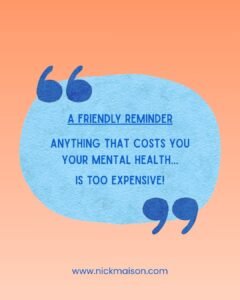
Somewhere along the way, visibility became a kind of validation. But when that visibility disappears, so can our sense of self-worth.
We’ve normalised checking our phones as soon as we wake up, before we’ve even spoken to the person lying next to us. We reach for a screen before we take in the beauty of the morning sunrise. Instead, we wake up and immediately enter a world of comparison before we’ve taken a full breath.
Let me ask you a question. If social media disappeared tomorrow, who would you really be without the audience?
Childhood in the Scroll Era
When I first covered this topic in 2024, one of the things that struck me most was the modelling effect. The original poem warned about the example we were setting for children.
Now those children are teenagers, and they’ve never known a world without the infinite scroll.
- They don’t remember boredom. Or at least, not the kind that led to imagination.
- They don’t wait for photos to be developed. They edit them instantly.
- They don’t just live experiences. They consider how those experiences will look online.
And the part we don’t always care to admit? Many adults are modelling the same behaviour. We hand over screens at restaurants to keep the peace. We check emails at the park. We film school plays instead of watching them.
Not because we don’t care, but because constant connectivity has become normal. But normal doesn’t always mean healthy.
Romance in the Age of Options
“Look Up” told a story of a missed connection; a girl never approached because someone was too busy staring at a phone.
In 2026, we don’t miss people because we’re not looking.
We miss them because we’re overwhelmed with options.
Dating has become a swipe, a scroll, a comparison exercise. Infinite choice sounds freeing. But too much choice often leads to detachment.
Why invest deeply when someone else is one tap away?
- We’ve replaced awkward, beautiful vulnerability with carefully crafted messages.
- We’ve replaced difficult conversations with silence.
- We’ve replaced presence with “typing…”
And yet, what most of us still want hasn’t changed.
- We want to be chosen.
- We want to be understood.
- We want someone to sit opposite us and truly listen.
With no filters, no distractions, and no audience to perform for.
Living for the Post, Not the Moment
There’s a subtle question many of us don’t say out loud:
If I don’t post it, did it even happen?
- We attend concerts and watch them through screens.
- We travel somewhere breathtaking and spend the first hour capturing it.
- We share our grief before we’ve processed it.
- We announce milestones at “optimal posting times”.
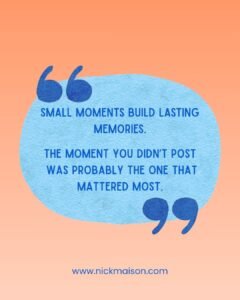
Documentation has overtaken digestion. But life isn’t meant to be constantly consumed. It’s meant to be experienced.
The irony? Some of our most meaningful memories were never posted. They were simply lived in the moment, a memory stored to look back on fondly.
Ask yourself this; do you experience moments differently when you know you’re going to post them online? Have you ever felt the pressure to make your life look better than it feels?
The Missed Moments and Lost Memories
Imagine this. You’re walking through town; ear buds in, mind half on a podcast, half on unread messages.
Someone smiles at you, but you don’t notice.
Your child says, “Watch this!” You nod, but you’re replying to something “urgent”.
Your partner starts telling you about their day. You say, “Sorry, what?” because you were halfway through a reel.
Alone, none of these may seem significant. They’re small snapshots in time. But I’d argue that if that is missing the point. Because life is built from those small moments.
And if we miss out on those small moments missed repeatedly, they distance us from reality and the opportunity to build lasting memories.
How Social Media Divides our Attention
Our attention has become a commodity. Social media platforms compete for it, their notifications are engineered to interrupt it, and their feeds are designed to hold it.
And we give it away far too freely.
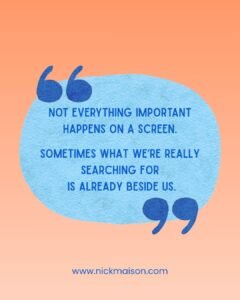
When we’re constantly interrupted, we struggle to sit quietly with our own thoughts. We struggle to focus. We struggle to tolerate a little unease or discomfort without seeking a distraction.
Boredom once led to moments of quiet reflection. Now it prompts us to tap the refresh button.
My worry is, when we never take the time to sit alone with our thoughts, we never quite learn what they’re trying to tell us.
This Isn’t About Demonising Technology
But let me be clear, technology isn’t the villain here. Technology and connectivity allows businesses to grow, families to stay connected, and social movements to gather momentum. It enables ideas to spread.
This article exists online; the irony in that isn’t lost on me either.
But tools become harmful when they use us more than we use them. The issue isn’t the phone in our pockets; it’s the habit, that reflex action of reaching for it before you reach for the world around you.
A Simple Digital Detox for Midlife
When people hear the phrase digital detox, they often imagine something extreme. Deleting every app, locking their phone away for a week, or escaping to a remote cabin without Wi-Fi.
The reality is, a healthy digital detox doesn’t mean getting rid of our electronic devices completely. It doesn’t mean we need to delete our social media accounts either.
For many people in midlife, the most meaningful changes are surprisingly small. It might be leaving your phone in another room while you eat dinner, taking a walk without headphones, or resisting the urge to check notifications first thing in the morning.
These small pauses allow something important to return.
- Space to think without interruption.
- Space to notice the world around you.
- Space to hear your own thoughts again.
Research increasingly shows that reducing screen time, even slightly, can improve focus, mood and sleep quality. But beyond the science, many people discover something far simpler when they step back from constant scrolling: life feels slower, calmer and more natural.
A digital detox isn’t about rejecting technology. It’s about remembering that our attention is one of the most valuable things we have, and choosing more carefully where we place it. To find out a little more, check out this handy guide where I break things down step by step.
Sometimes, the most powerful reset begins with the smallest decision. Putting the phone down.
Disconnect to Reconnect
This isn’t about deleting every app or moving to a cabin in the woods.
It’s about making small, deliberate changes to our relationship with technology.
- Put your phone in another room at dinner.
- Go for a walk without headphones.
- Make eye contact with the barista instead of scanning your screen.
- Call someone instead of sending a voice note.
- Leave your phone in your pocket at your child’s football match.
Because the truth is, no one lies on their deathbed wishing they’d spent more time optimising content.
They remember the conversations, the laughter, the way someone looked at them across a table.
They remember how they felt.
Final Thoughts
You don’t need a dramatic life event to reassess your priorities. You don’t need to wait for burnout, for distance in your relationships, for that creeping sense of emptiness that no amount of scrolling seems to soothe.
You can choose differently.
In “Look Up”, the message was simple: put the phone down and experience the world. Twelve years later, the message has evolved. It’s not just about looking up from a screen; it’s about looking up from autopilot.
From the endless distraction, from the illusion that more connection online equals more connection in life. You don’t have to reject the modern world to live well in it.
So, here’s your invitation.
The next time you check your screen-time report, don’t just glance at the number.
Ask yourself:
- Does this reflect how I want to spend my life?
- What would reducing it by 10% give back to me?
- Who would benefit most if I were more present?
Then look up. Because the life that you’re waiting to feel more connected to? It’s happening right now. And it deserves your full attention.
So, before your week fills up again; before the scroll takes over.
Nick Maison is a UK-based health and wellbeing writer who supports men and women over 40 navigating stress, mental wellbeing and sustainable lifestyle change. Drawing on personal experience combined with research-informed, evidence-based insight, he shares practical, sustainable approaches to building calmer, healthier and more balanced lives in midlife.